By Batanai Mutasa
CAPE TOWN – As global demand for critical minerals accelerates the green transition, resource-rich nations face a dual mandate to supply the world with strategic minerals, but not at the expense of people or the planet. For Zimbabwe, this presents both a challenge and an opportunity.
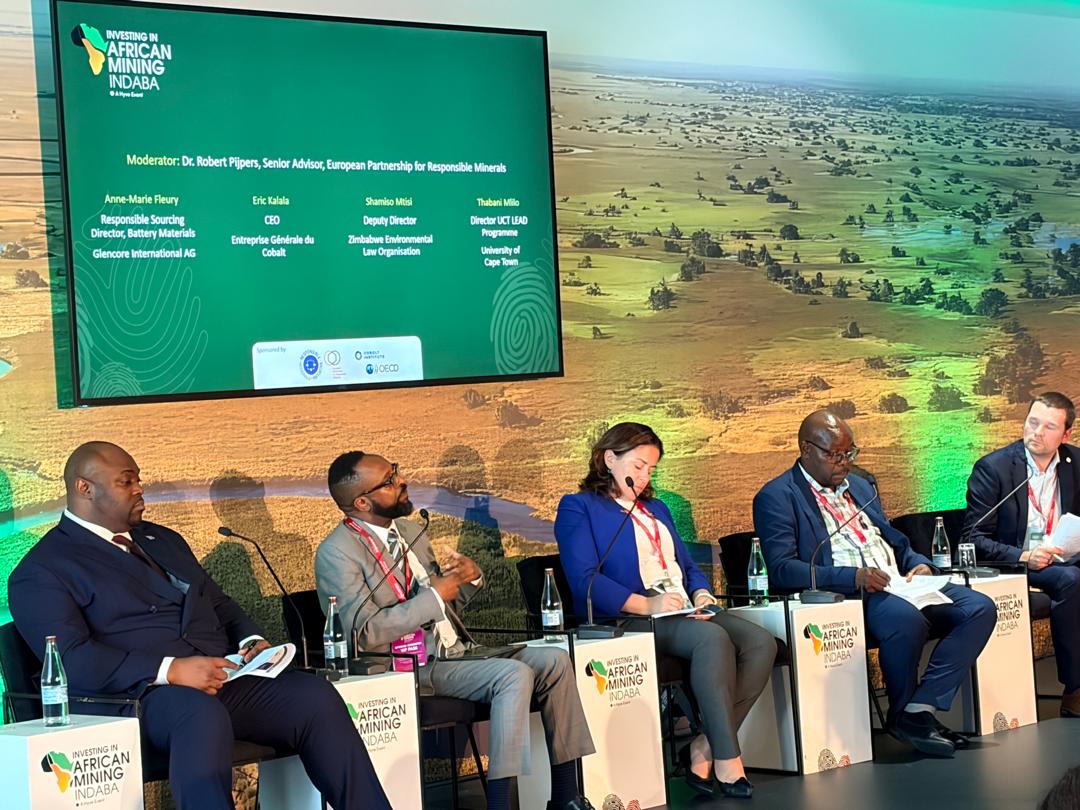
Speaking on 10 February 2026 at the Investing in Africa Mining Indaba, Shamiso Mtisi, Deputy Director of the Zimbabwe Environmental Law Organisation (ZELO), portrayed a country in transition. Zimbabwe, he said, is actively recalibrating its policies, strengthening governance, and signaling to the world that it is open for responsible investment.
Mtisi spoke on a high-level panel convened by the Organisation for Economic Co-operation and Development (OECD), the Responsible Minerals Initiative (RMI), the Cobalt Institute, and the European Partnership for Responsible Minerals (EPRM). The session, titled “Dual-use dilemma: Balancing reliable mineral access and ensuring responsible supply chains for green transition and strategic technologies,” brought together global stakeholders to tackle one of the sector’s most pressing tensions.
In his presentation, “Changed dynamics in Zimbabwe’s ASM lithium sector, and integration of artisanal and small-scale mining into formal markets and supply chains,” Mtisi highlighted the sector’s transformation over the past decade. “An estimated 500,000 to 1.5 million people are now engaged in artisanal and small-scale mining (ASM), primarily in gold, chrome, and lithium,” he said. “It has become a critical livelihood source, particularly for unemployed youth.”
But growth has brought complexity. The lithium boom of 2022–2023 exposed gaps in regulation, traceability, and environmental oversight. In response, the Zimbabwean government took decisive action, effecting an export ban on unprocessed lithium, the licensing of Approved Processing Plants (APPs), and the channeling of ASM lithium into formal markets.
According to a recent Mine to Market study by ZELO, more than 17 such plants are now operational, many purchasing material directly from artisanal miners. While challenges remain, including low lithium prices that have led some miners to abandon sites, the infrastructure for formalisation is now in place.
Mtisi described a deliberate and strategic pivot toward investor diversification and international re-engagement. Zimbabwe has historically relied heavily on a single source of investment in its critical minerals sector, a concentration that carries significant economic and geopolitical risk. However, he applauded the country’s new investor re-engagement strategy, underpinned by ease-of-doing-business reforms, a “no-questions-asked” policy for ASM gold producers, and ongoing legal reforms – including the Mines and Minerals Amendment Bill, which introduces provisions on responsible mining and Environmental, Social and Governance (ESG) criteria. ZELO is also providing technical support for the development of a National Critical Minerals Strategy.
The organisation is working with the government implement Responsible Mining Audit (RMA) programmes, which assess compliance across labour, immigration, environment, community benefits, taxation, and safety standards. Originally commissioned in 2023, the RMA is now being scaled with ZELO’s technical assistance, bringing compliance inspections directly to mine sites.
Mtisi also commended state enterprises for stepping up, noting that ZELO has partnered with the Zimbabwe Investment Development Agency (ZIDA), the Minerals Marketing Corporation of Zimbabwe (MMCZ), and Fidelity Printers to embed ESG standards into their operations.
His message to investors at the Indaba was clear: Zimbabwe is ripe for investment, not because standards are low, but because they are rising. Not because oversight is weak, but because systems are being built to match international best practice, and not because the work is complete, but because the direction is unmistakable.
“The key is creating value for Zimbabwe and opening the country for investment,” Mtisi explained. “The government is implementing ease-of-doing-business reforms, considering tax holidays, and ensuring investors do not face a long list of taxes. That’s critical to making Zimbabwe attractive. I believe this is the time, because competition in the sector is essential.”
Zimbabwe is pursuing a model in which responsible mining translates into enhanced profitability, sustainable market linkages, and shared value, one that recognises environmental protection and worker safety not as barriers to investment, but as its foundation.