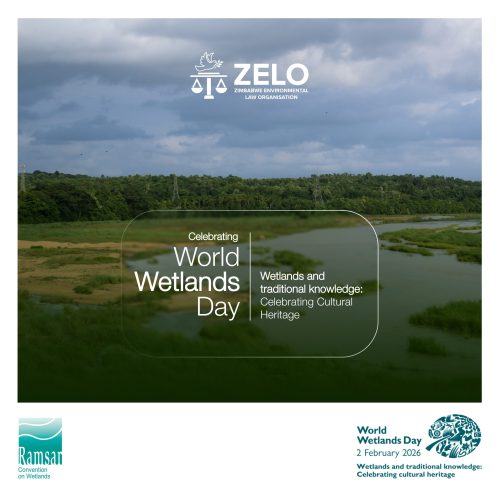
2 February 2026
Aligned with this year’s theme, “Wetlands and traditional knowledge: Celebrating cultural heritage,” World Wetlands Day highlights the enduring role of such knowledge in sustaining wetland ecosystems and preserving cultural identity.
The Zimbabwe Environmental Law Organisation (ZELO) joins the global commemoration by calling for greater integration of communities in conserving these vital ecosystems, reflecting the organisation’s people-centred and inclusive values. ZELO emphasises that traditional knowledge systems and the active participation of local communities are essential to effective wetland conservation.
Thus, recognising and incorporating traditional knowledge into global and national wetland and biodiversity monitoring improves the understanding of ecosystem changes and enables the meaningful involvement of indigenous peoples in wetland management.
Across cultures, wetlands are cultural landscapes embedded in identity, art, and spirituality. However, rapid social and economic transformations in recent decades have threatened the preservation of this heritage in many parts of the world. Significant declines have been recorded in Latin America, the Caribbean, and Africa, while degradation has also increased in Europe, North America, and Oceania.
The accelerated loss of wetlands led to the signing of the Ramsar Convention on Wetlands on 2 February 1971 and this day reminds us of the urgent need to protect these natural habitats, which continue to disappear faster than they are restored. Wetland conservation is a critical global priority, particularly given the ongoing deterioration in their ecological character. According to the Global Wetland Outlook 2025, rates of degradation vary by region and over time, influenced by factors such as development and land-use change.
Zimbabwe has made commendable strides in wetland conservation, working towards its commitments under the Ramsar Convention and recognising wetlands as vital for biodiversity, water regulation, and climate resilience. Under the National Development Strategy 1 (NDS 1), efforts were made to protect critical wetland ecosystems and promote sustainable practices. The National Development Strategy 2 (NDS 2) further commits to strengthening the regulatory framework to protect wetlands from encroachment, thereby improving water security and carbon sequestration. The Constitution of Zimbabwe, specifically Section 73, along with the Environmental Management Act and supporting regulations, provides a legal foundation for wetland protection.
Notably, Zimbabwe holds the Ramsar Conference of the Parties Presidency for the 2025–2028 triennium, guiding the convention’s implementation and strategic direction. This offers an opportunity to lead in conserving pristine wetlands and rehabilitating degraded ones. The country has committed to restoring 250,000 hectares of degraded land and designating five new Ramsar sites by 2030.
Despite these policy commitments, wetland integrity remains threatened by encroachment from agriculture, mining, and urban development. In Harare alone, an estimated 3,717 hectares of wetlands have been affected by construction, representing about 16% of the city’s wetlands.
It is, therefore, imperative to embed cultural values and traditions into wetland management as this remains one of the most effective ways to achieve good ecological conditions in these ecosystems.
To ensure that traditional knowledge and cultural heritage are leveraged in wetlands protection, the Zimbabwe Environmental Law Organisation recommends the following:
- The Government of Zimbabwe should integrate science, law and traditional knowledge systems in wetland governance, ensuring that customary protection practices are formally recognised and enforced
- Government and Development Partners should encourage investment in community-led wetland restoration projects, particularly in areas affected by mining, agriculture, and urban expansion, while safeguarding cultural heritage and livelihoods
- Wetland management should be integrated into national and local land-use planning to enhance conservation efforts, including stricter Environmental Impact Assessment (EIA) enforcement and prohibition of destructive activities in wetlands and buffer zones.