By Michelle Chiwanga
What happens when a room full of aspiring lawyers is invited to look beyond the law as they know it?
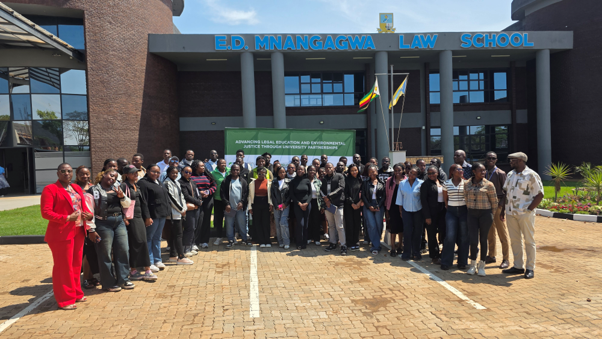
For the students gathered at the Emmerson Dambudzo Mnangagwa Law School at Midlands State University, the second day of the Environmental Law Training was an invitation to do precisely that.
Held from the 5th to the 6th of October 2026, the training formed part of an initiative to strengthen environmental legal education and build the capacity of students to undertake environmental legal research, community outreach and advocacy. The initiative recognises the increasingly urgent role of law in responding to the interconnected crises of climate change, biodiversity loss and pollution.
But day two was not simply about learning more law. It was about learning to see differently. From discussions on environmental justice and human rights to practical case studies, spirited debate, environmental impact assessments, policy communication and reflections on life beyond the traditional legal career, the day repeatedly challenged students to move from passive knowledge to active engagement.The participatory nature of the training was apparent throughout the day. The programme was deliberately designed to move beyond conventional lectures, incorporating discussions, practical exercises, case studies, group work and student-led presentations.In many ways, that was the quiet strength of the training: everyone had something to learn, and everyone had something to contribute.
Environmental justice: beyond the courtroom
The morning’s session on Environmental Justice and the Role of Environmental Lawyers, led by Mr B.T.A. Mhlanga, placed the question of justice at the heart of environmental legal practice. Mr Mhlanga’s passion for environmental justice was evident as he explored the role of the environmental lawyer through the lens of section 73 of the Constitution, which protects the right to an environment that is not harmful to health or well-being and provides for environmental protection for present and future generations.
The discussion opened a broader understanding of what it means to pursue environmental justice.The lawyer, in this conception, is not simply someone who argues a case once a dispute has reached court.
The lawyer can strategise.
The lawyer can investigate.
The lawyer can identify avenues for redress.
The lawyer can work towards the outcome that affected communities and victims actually seek.
And sometimes, achieving justice may require looking beyond the courtroom altogether.
This was an important shift in perspective. Litigation is a tool, but it is not the toolbox. Environmental justice may demand a combination of legal, strategic and advocacy approaches, carefully selected according to the circumstances of the people and communities involved.That framing encouraged students to think not only about what the law says, but about what can be done with the law.
When theory met the hypothetical
The training then moved from discussion to application.Students were divided into groups and presented with hypothetical environmental-law case studies involving different environmental challenges. Their task was not simply to identify the relevant legal principles. They had to grapple with the harder question: what would you actually do?
The exercise required students to explore possible resolutions, identify potential roadblocks and consider strategies for overcoming them.It was, in miniature, a rehearsal for practice. Environmental disputes rarely arrive neatly packaged with one legal provision, one affected party and one obvious solution. They come with competing interests, institutional constraints, incomplete information and sometimes several possible pathways to an outcome.
The group exercise allowed students to experience that complexity in a space where getting it wrong was part of getting it right. A legal problem was no longer merely something to answer.It became something to navigate.
Understanding the environmental impact assessment
The practical discussions also provided an opportunity to interrogate one of the most important tools through which environmental considerations enter development and mining decisions: the Environmental Impact Social Assessment (ESIA).
An ESIA adopts a broader lens, expressly considering both environmental and social effects. The Environmental Management Act currently describes Zimbabwe’s process as an ESIA process and identifies prospecting, mining and quarrying among activities requiring such assessment before implementation.
That distinction matters because the effects of mining are rarely confined to ecosystems in the narrow sense. Mining can affect water, land, livelihoods, communities, health and cultural interests. A broader environmental and social assessment therefore asks not only “What will happen to the environment?”, but also who will be affected, how will they be affected, and what measures are necessary to address those effects?”
The discussion of environmental assessment became particularly timely in light of Zimbabwe’s proposed Mines and Minerals Bill, 2025 and the Environmental Management Amendment Bill, 2026 .The Mines Bill represents an attempt to modernise the country’s mining-law framework and introduces stronger environmental and social considerations into the regulation of mining. Among its proposed reforms is a closer relationship between environmental and social compliance and the retention or exercise of mining rights.The issue is not merely academic.Under the existing framework, the Environmental Management Act requires prescribed projects to obtain environmental approval before implementation. Yet the relationship between the acquisition of a mining right and the subsequent environmental authorisation has generated legal debate.
The proposed Bill itself appears to engage directly with this problem. One reported formulation of the Bill provides that an EIA would not be a condition precedent to the issuance of a mining right or title, but would instead be required before the exercise of the right. The Environmental Management Amendment Bill also seeks to address the gap by proposing that a license issued under any enactment by nay licensing authority with respect to a project that requires an ESIA shall not be valid unless the Director General has issued an ESIA certificate.
A debate that brought the room alive
If the practical exercises tested students’ ability to solve problems, the debate tested their ability to defend ideas.The training created space for a lively, scintillating debate in which students could engage with competing positions in an atmosphere that remained welcoming and conducive to learning.There was room for disagreement without hostility and confidence without intimidation.That distinction matters.
For students, particularly those encountering environmental law for the first time, an environment in which one can ask a question without fear of being judged is itself a form of education. It allows curiosity to take root. It makes unfamiliar concepts less intimidating and encourages students to engage rather than retreat.The debate therefore became more than an entertaining interlude. It demonstrated one of the most valuable features of legal education: the ability to disagree thoughtfully, listen carefully and reconsider one’s position.
Climate change and human rights
The day’s engagement with environmental justice was complemented by a session on Climate Change and Human Rights, facilitated by Ms. Hazel Tariro Chimbiro. The subject reflected the wider rationale for the training. Environmental challenges cannot always be confined within the boundaries of a single legal discipline. Climate change, biodiversity loss and pollution intersect with questions of rights, livelihoods, governance and justice.
For students, this reinforced an important lesson: environmental law is not an isolated island within the legal system. It is connected to many of the questions that lawyers will encounter throughout their careers.
From legal research to policy
The afternoon turned towards another skill that is increasingly important for aspiring environmental lawyers: communication. Ms Hazel Tariro Chimbiro led a session on policy brief drafting, communication and dissemination.The session recognised that good research does not achieve its full potential simply because it is correct. Research must also travel. It must reach policymakers, communities, institutions and other audiences in forms that they can understand and use.
For law students accustomed to cases, statutes and lengthy academic writing, the policy brief offers a different discipline: distilling complex research into clear, accessible and actionable communication.But Mrs Chimbiro’s contribution went beyond the mechanics of writing.
Looking beyond the traditional legal career
As the training drew towards its conclusion, Ms Hazel Tariro Chimbiro offered advice that was particularly timely for many of the participants, most of whom are approaching the end of their law degrees.Her message was one of possibility.Students were encouraged not to become rigid in their understanding of what it means to be a lawyer or what a legal career must look like. The traditional pathways of legal practice are only part of the picture. Beyond them lies a plethora of opportunities in which legal training can be applied in different ways.
The message was especially fitting in the context of environmental law.Environmental work sits at the intersection of law, policy, research, advocacy, governance and community engagement. It therefore offers precisely the kind of space in which a legal education can travel beyond the conventional boundaries of legal practice.
For students standing at the threshold between university and professional life, the advice carried a particular resonance: do not allow the image of the lawyer you have inherited to become a cage.There is more than one way to build a legal career. There is more than one way to use a law degree. And there is certainly more than one way to make an impact.
Learning together, looking ahead
The final part of the day brought students back into the spotlight through group research and student presentations, followed by questions and discussion.It was an appropriate ending to a day built around participation.Students had listened, questioned, debated, researched, strategised and presented. The movement from facilitator-led discussion to student-led engagement captured the broader philosophy underpinning the training: environmental legal education should equip students not merely to know the law, but to use it.
The training’s stated objectives include enhancing students’ knowledge of environmental law and strengthening their capacity to conduct legal research. But Day Two suggested that capacity is about more than technical competence. It is also about curiosity.It is about the courage to ask difficult questions. It is about the ability to see a problem from more than one angle.It is about knowing when litigation is appropriate and when another strategy may produce a better outcome.And perhaps most importantly, it is about understanding that a law degree does not have to end with a single predetermined destination.
Day Two therefore left participants with more than notes in their notebooks. It left them with questions to carry forward: Where can environmental law take us? What can we do with the law beyond the courtroom? And how can we use our legal training to pursue meaningful outcomes for people and the environment?
For a generation of law students preparing to enter an increasingly complex world, those may be among the most valuable questions a training could leave behind.
* Michelle Chiwanga is a Law Student at the Emmerson Dambudzo Mnangagwa Law School at Midlands State University