By Shingai C. Mujeri
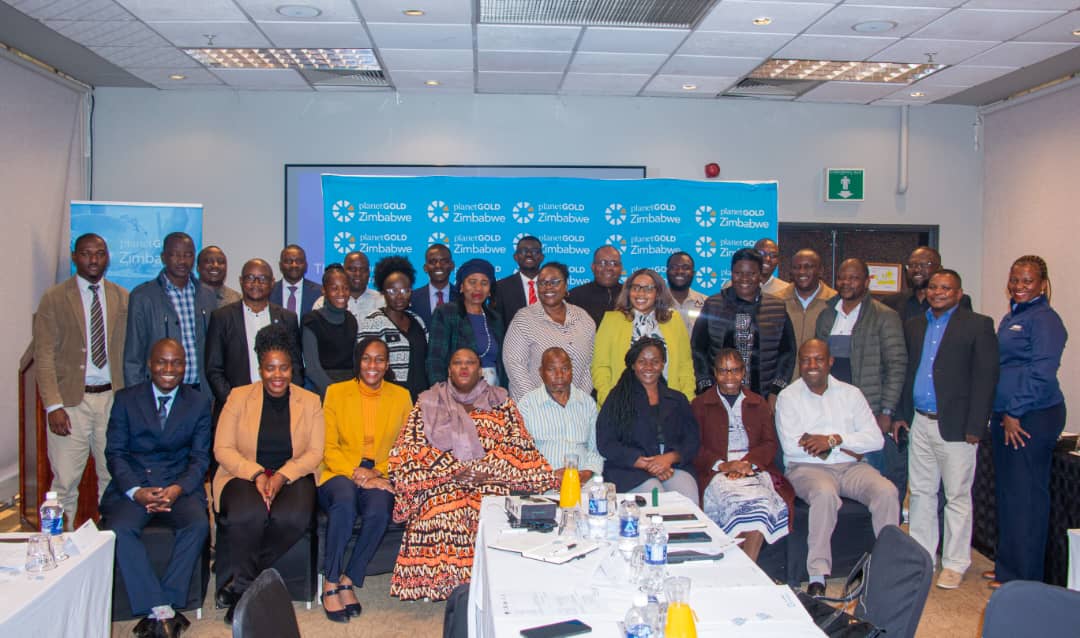
I recently attended the National Dialogue on Access to Finance for Artisanal and Small-Scale Gold Mining (ASGM) under the PlanetGOLD Zimbabwe Programme in Harare, joining government officials, financial institutions, development partners, miners, legal practitioners, engineers and civil society to deliberate on one persistent question: Why does a sector that contributes significantly to Zimbabwe’s gold production continue to struggle to access finance?
Like many entering the dialogue, I assumed the challenge was simply a shortage of capital. Instead, I left with a different conclusion. The real obstacle is not the absence of finance, but a mismatch between the realities of artisanal and small-scale mining and the way our financial systems define bankability.
The discussions revealed that banks are not unwilling to finance miners. Equally, miners are not unwilling to formalise their operations. The challenge is that both are operating from fundamentally different perspectives. Commercial banks assess projects through a traditional corporate finance lens, requiring collateral, audited financial statements, production history, predictable cash flows and compliance with Environmental, Social and Governance (ESG) standards. Yet most artisanal and small-scale miners begin with little more than a mining title, geological potential and the determination to build a viable business. Their greatest asset lies beneath the ground, but that potential is rarely recognised within conventional lending frameworks.
This creates a financing paradox that repeatedly surfaced throughout the dialogue. Banks require miners to demonstrate production before extending finance, while miners need finance to reach production. Banks require collateral before lending, yet miners need investment to develop the very assets that could eventually become collateral. In essence, banks want the gold, but miners need the money to produce the gold.
Another important lesson emerged regarding the role of financial institutions themselves. Banks are custodians of capital rather than owners of it. Much of the funding available to local banks is sourced from international development finance institutions, whose capital is increasingly tied to sustainability and responsible investment principles. As a result, ESG has evolved from being merely a compliance obligation into a financing requirement. Environmental stewardship, labour standards, governance systems and responsible mining practices now influence whether capital reaches mining projects. In many respects, ESG has become the new licence to operate.
The dialogue also highlighted that Zimbabwe is not confronting this challenge alone. Countries such as Colombia, Peru, Uganda and Ghana have adopted innovative financing models that acknowledge the realities of artisanal mining. Government-backed guarantee schemes, blended finance, production-based lending, equity investments and partnerships between governments, banks and development partners have helped reduce lending risks while improving financial inclusion. Rather than expecting miners to fit conventional banking products, these countries have reshaped financial products to fit the mining sector.
Perhaps the most thought-provoking discussion centred on mining rights themselves. If Government entrusts a miner with exclusive rights to exploit a mineral resource on behalf of the nation, why do those rights carry so little financial value? Zimbabwe has already recognised agricultural offer letters and long-term leases as instruments capable of unlocking finance. The dialogue challenged us to consider whether mining rights should similarly be recognised as bankable assets capable of supporting access to credit.
Formalisation also emerged as a recurring theme, but not in the narrow sense of registration. Participants emphasised that formalisation should be understood as building investment-ready mining enterprises through sound governance, financial management, proper record keeping, environmental compliance, occupational health and safety, and responsible mining practices. Registration alone will not unlock finance unless it is accompanied by the institutional and business capacity that financial institutions require.
One proposal that particularly resonated with me was the call for the establishment of a dedicated Miners’ Bank, similar to Agribank for farmers. Agriculture has long benefited from a financial institution that understands farming cycles, sector-specific risks and appropriate financing models. Mining deserves the same. A specialised Miners’ Bank would understand geological uncertainty, mine development cycles, seasonal production and mineral valuation. More importantly, it would assess miners through the realities of the mining industry rather than applying generic corporate lending standards. Such an institution would shift the narrative from viewing artisanal miners as lending risks to recognising them as investment opportunities capable of driving national economic growth.
The discussions equally pointed to the need for a stronger role by Government. A recapitalised and modernised Mining Industry Loan Fund, supported by a national guarantee scheme, could reduce lending risks for commercial banks while unlocking private investment into the sector. Combined with reforms that recognise mining rights as collateral and financing products tailored to different stages of mine development, such interventions could fundamentally transform access to finance for artisanal and small-scale miners.
These conversations reinforced an important reality. The challenge facing Zimbabwe’s ASGM sector is not simply a shortage of finance. It is a legal, institutional and financial architecture that was largely designed for established corporate enterprises rather than small-scale mining. If we continue measuring artisanal miners using corporate standards alone, we risk overlooking the immense mineral potential that already exists beneath our soil.
These are precisely the kind of policy and legal questions that sit within the work of the Zimbabwe Environmental Law Organisation (ZELO). Strengthening sustainable mining governance, promoting responsible investment, improving financial inclusion and advancing legal reforms that respond to the realities of artisanal and small-scale mining are all essential if Zimbabwe is to fully realise the developmental potential of its mining sector.
From the dialogue, I am convinced that these priorities are clear:
- Bankability must be redefined to recognise mineral potential and the different stages of mine development, rather than relying solely on conventional corporate lending criteria.
- Zimbabwe needs financing products specifically designed for ASGM, reflecting the realities of exploration, mine development and production instead of adapting products created for large corporates.
- A dedicated Miners’ Bank should be established, similar to Agribank, with the expertise and mandate to understand the mining industry and provide financing informed by mining realities rather than generic banking models.
- Mining rights should be recognised as bankable assets, much like agricultural offer letters and long-term leases, enabling miners to leverage their legal rights to unlock finance.
- Government should establish a National ASGM Guarantee Scheme, supported by a strengthened Mining Industry Loan Fund, to reduce lending risks and crowd in greater private sector investment.
- Zimbabwe should adopt a dedicated ASGM Policy or National Strategy that distinguishes artisanal and small-scale mining from large-scale mining through proportionate legal, regulatory and financing frameworks.
- Formalisation must extend beyond registration to include governance, financial literacy, production records, environmental compliance, occupational health and safety, ESG readiness and investment preparedness.
- Banks, government, miners and development partners must co-create financing solutions, ensuring that financial products are informed by the operational realities of artisanal and small-scale mining rather than being developed in isolation.
- ESG is no longer optional. Responsible mining practices increasingly determine access to both domestic and international finance.
For Zimbabwe, the challenge is no longer deciding whether artisanal and small-scale mining is worthy of investment. The sector has already demonstrated its economic significance. The real challenge is whether we are prepared to redesign our legal and financial systems to unlock that potential. If we can move beyond seeing ASGM as a high-risk sector and instead recognise it as a strategic driver of economic development, we can build a financing ecosystem that supports responsible mining, expands financial inclusion and transforms Zimbabwe’s mineral wealth into sustainable national prosperity.